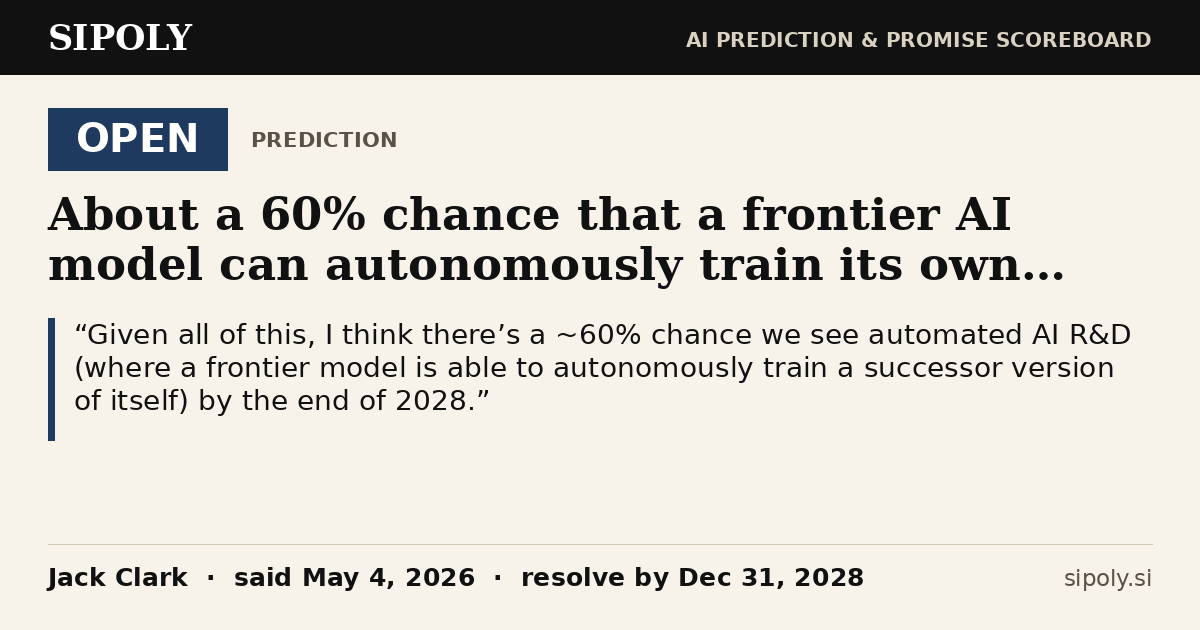
About a 60% chance that a frontier AI model can autonomously train its own successor by the end of 2028
“Given all of this, I think there’s a ~60% chance we see automated AI R&D (where a frontier model is able to autonomously train a successor version of itself) by the end of 2028.”
Context: Jack Clark, Anthropic co-founder, in the essay "Import AI 455: Automating AI Research" ("AI systems are about to start building themselves") in his personal Import AI newsletter, 4 May 2026. The essay opens with the same view ("a likely chance (60%+) that no-human-involved AI R&D … happens by the end of 2028"), says he does not expect it in 2026, and adds: "If you had to push me for a 2027 probability, I’d say 30%." He also says a proof-of-concept at the non-frontier stage could come first. Import AI is written in a personal capacity, not as an Anthropic forecast. Sources: (1) Import AI 455 on jack-clark.net (primary); (2) The Decoder, "Anthropic co-founder maps out how recursive AI improvement could outpace the humans meant to supervise it" ("roughly 60 percent by the end of 2028, and 30 percent by 2027"); (3) Business Insider, "OpenAI Hires in Preparation for AI That Could Train Itself" (May 2026: "roughly 60% chance of seeing AI research and development without human involvement by the end of 2028"). On 12 Oct 2026 he moved his central year to 2027 (clark-full-rsi-possible-2027).
How we judge it
Our interpretation: YES if by 31 Dec 2028 a frontier AI model is shown to have autonomously trained a successor version of itself, with AI systems rather than human researchers doing the research and training work ("no-human-involved AI R&D"), as credibly documented by the developer with technical detail or by independent evaluators and broadly accepted by independent experts; a developer's own claim does not count on its own, and a proof-of-concept with a non-frontier model does not count. Stated probability about 60%, so it is scored on calibration.
Resolution criteria are our interpretation of the claim, written before grading. Methodology
- Said
- Resolve by
- Due in 785 days
- Verdict
- Open
- Stated probability
- 60%
- Specificity
- 2 of 3 (dated, some interpretation)
Share this scorecard
Post on X LinkedIn Share image (PNG)
Embed / Cite
The embedded card is live: it shows the current verdict, with the date the data was read. If a verdict is corrected later, the card changes too, so cite the page and its date for a fixed record.