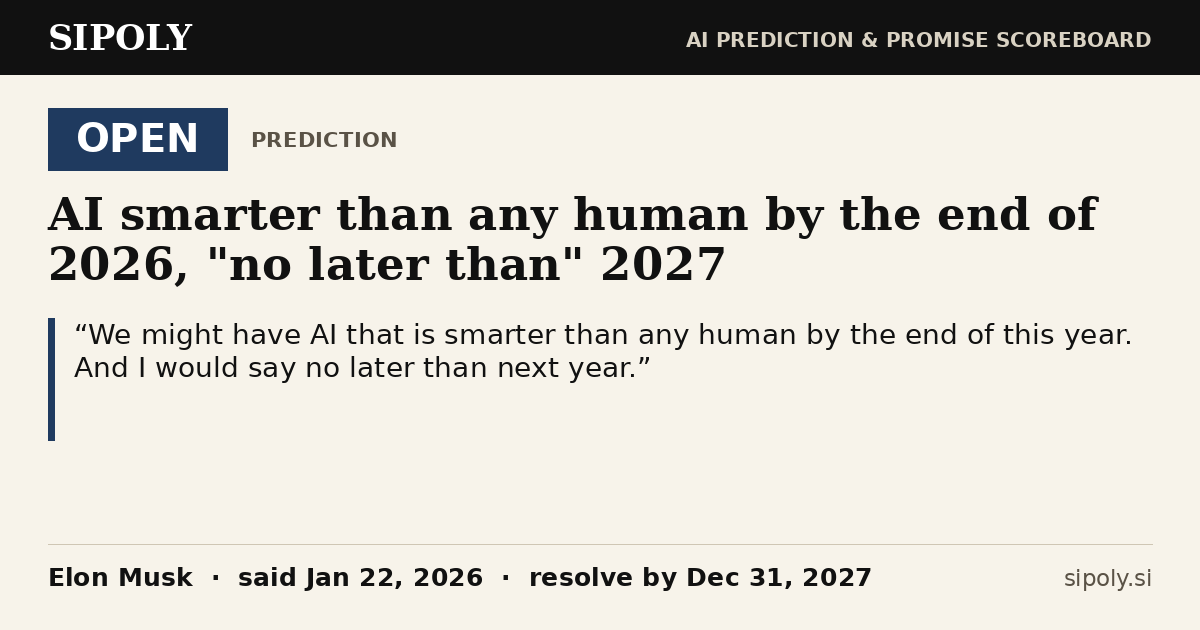
AI smarter than any human by the end of 2026, "no later than" 2027
“We might have AI that is smarter than any human by the end of this year. And I would say no later than next year.”
Context: Elon Musk in conversation with Larry Fink at the World Economic Forum in Davos, 22 Jan 2026 (official WEF transcript; C-SPAN captions and the Rev transcript have the same words, with "I think" before "we might"). Asked about the next three, five or ten years. In the same answer he said AI will be smarter than all of humanity collectively "probably by 2030 or 2031". This is a later statement that moves the outer date of his June 2025 forecast (digital superintelligence this year or next) out to 2027.
How we judge it
Our interpretation: correct if by 31 Dec 2027 an AI system is broadly recognized as smarter than any human (across essentially all cognitive domains) by independent experts; a developer's own claim does not count on its own. Same bar as musk-digital-superintelligence-2026.
Resolution criteria are our interpretation of the claim, written before grading. Methodology
- Said
- Resolve by
- Due in 419 days
- Verdict
- Open
- Stated probability
- None stated
- Specificity
- 1 of 3 (vague or hedged)
Revised claim
Elon Musk made 2 related statements on this subject at different times. Each one is quoted from its own source and graded on its own against its own deadline; linking them does not change any verdict or score.
- Said Open Digital superintelligence "this year" (2025), or "next year for sure" · resolve by
- Said Open AI smarter than any human by the end of 2026, "no later than" 2027 (this claim) · resolve by
Resolve-by dates across these statements, oldest statement first: → .
Share this scorecard
Post on X LinkedIn Share image (PNG)
Embed / Cite
The embedded card is live: it shows the current verdict, with the date the data was read. If a verdict is corrected later, the card changes too, so cite the page and its date for a fixed record.